
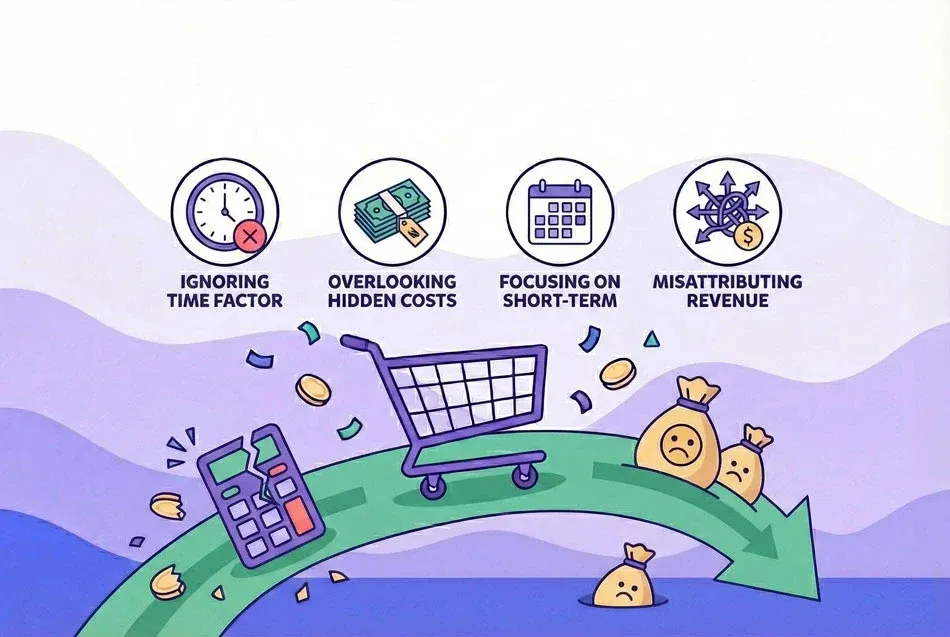
Not Including All Costs
Underestimating costs by only considering direct ad spend is the most common ROI calculation error, typically overstating true ROI by 50-200%. Incomplete cost accounting leads to false confidence in campaign profitability and misguided investment decisions.
Costs commonly excluded but essential for accurate ROI:
Marketing costs beyond ad spend include creative production costs (design, copywriting, photography, video), marketing software and tools (email platforms, analytics, CRM, ad management), agency fees and contractor costs, marketing team salaries and benefits, and promotional discounts or coupons used for acquisition.
Product and fulfillment costs include cost of goods sold (manufacturing or wholesale costs), packaging and shipping materials, shipping carrier costs, warehouse and fulfillment labor, payment processing fees (2-3% of transaction value), and returns processing and restocking.
Overhead allocation means a proportional share of office space, utilities, customer service costs, and administrative overhead should be allocated to campaigns. If marketing represents 20% of company activity, allocate 20% of overhead costs.
Without comprehensive cost tracking, a campaign appearing to deliver 300% ROI might actually generate only 100% ROI when all costs are included - still profitable, but far less attractive than believed.
Ignoring Long-Term Value
Focusing solely on short-term gains misses the bigger picture and systematically undervalues strategies with compounding returns. Some investments show poor immediate ROI but deliver substantial long-term benefits that justify ongoing commitment.
Why this pitfall is dangerous:
SEO and content marketing often show 0-50% ROI in months 1-3 as you invest in content creation and link building without immediate ranking improvements. By months 6-12, as content ranks and attracts organic traffic, ROI often reaches 300-500%+ with minimal ongoing spend. Evaluating only immediate returns would kill these high-value strategies.
Email list building requires upfront investment in lead magnets, automation setup, and list growth tactics that show limited immediate ROI. However, owned email audiences generate recurring revenue at near-zero marginal cost for years, delivering cumulative ROI of 1000%+ over a subscriber's lifetime.
Brand awareness campaigns create lasting mental availability that reduces future acquisition costs and improves conversion rates across all channels. Immediate ROI might be 50-100%, but the compounding effect of brand equity delivers multiples of that over time.
Short-term ROI obsession leads to chronic underinvestment in growth drivers and overinvestment in quick wins that don't build lasting value.
Not Segmenting by Channel or Campaign
Grouping ROI across all marketing activities masks underperforming areas and obscures optimization opportunities. Blended ROI of 200% could hide one channel at 400% carrying another at 50%.
Why blended metrics mislead:
Channel-blinded optimization means without knowing email delivers 500% ROI while display shows 75% ROI, you might cut overall marketing budget when you should shift from display to email. Aggregated data hides actionable insights.
Product-level blindness means high-margin hero products might show 400% ROI while low-margin commodity items achieve 50% ROI. Without segmentation, you can't focus ad spend where it drives profitability.
Customer segment confusion happens when new customer acquisition shows 150% immediate ROI that grows to 400% lifetime ROI, while repeat customer marketing shows 500% immediate ROI. Blended metrics obscure which strategies deserve investment.
Campaign-type mixing occurs when branding campaigns show 100% ROI while conversion-focused campaigns hit 300% ROI. Both are valuable but serve different purposes and warrant different investment levels. Aggregation prevents proper evaluation.
Failing to Adjust for External Factors
External influences like economic conditions, seasonality, competitive activity, and consumer behavior shifts impact ROI independently of campaign quality. Misattributing externally driven ROI changes to campaign performance leads to wrong optimization decisions.
External factors that distort ROI:
Seasonality creates predictable ROI patterns. Holiday periods typically show 150-200% of baseline ROI due to elevated purchase intent and conversion rates, while post-holiday periods drop to 60-80% of baseline. Crediting improved Q4 ROI to campaign optimization when it's actually seasonal lift leads to overinvestment in tactics that won't work year-round.
Economic conditions affect consumer spending and competitive intensity. Recessions reduce discretionary spending, compressing ROI across all campaigns. Economic booms increase consumer confidence, inflating ROI. Blaming marketing for macro-driven ROI changes is counterproductive.
Competitive pricing and promotional activity shifts customer behavior. Aggressive competitor sales may temporarily depress your ROI as customers comparison shop, even if your campaigns haven't changed. Without monitoring competitive activity, you might "optimize" campaigns that aren't actually the problem.
Platform algorithm or policy changes alter campaign performance overnight. iOS privacy updates, Google algorithm changes, or platform policy shifts can dramatically impact ROI independently of campaign quality. Failing to track platform changes leads to misdiagnosis.
Supply chain or inventory issues impact conversion and profitability. Out-of-stock hero products or delayed shipping times reduce conversion rates and increase returns, depressing ROI through mechanisms unrelated to marketing effectiveness.
Confusing Correlation with Causation
When ROI improves, the natural tendency is to credit recent campaign changes. However, multiple factors influence ROI simultaneously, and timing coincidence doesn't prove causal relationship.
Why false attribution is dangerous:
New campaigns launching during seasonal upswings appear highly effective when they're simply riding seasonal trends. Crediting the campaign leads to overinvestment in tactics that don't actually drive the results.
Halo effects from brand campaigns improve performance across all channels. Attributing conversion campaign ROI improvement to tactical optimization misses that brand awareness did the heavy lifting. You might then cut brand spend thinking it's unnecessary.
Competitive dynamics shift continuously. Your ROI might improve because competitors paused their aggressive promotions, not because your campaigns optimized. False confidence in campaign changes leads to doubling down on tactics that won't work when competitive environment shifts back.
Random variation gets mistaken for meaningful improvement. ROI fluctuates naturally - a week of 250% ROI following weeks of 200% might be noise, not signal. Reacting to noise wastes resources on changes that don't matter.
Comparing Incomparable Metrics
Treating all ROI numbers as equivalent regardless of how they're calculated creates confusion and poor decision-making.
Common comparison errors:
Marketing ROI vs. true ROI confusion happens when one team calculates ROI using only marketing costs while another includes all business costs. The numbers appear comparable but measure completely different things. Always clarify calculation methodology.
Immediate vs. lifetime ROI mixing occurs when comparing new customer acquisition (150% immediate, 400% lifetime) against retention campaigns (500% immediate). Without specifying time horizon, the comparison is meaningless.
Gross vs. net profit inconsistency means if one analysis uses gross profit (revenue minus product costs) while another uses net profit (revenue minus all costs), ROI calculations are incompatible. Standardize profit definitions.
Attribution model mismatches happen when comparing last-click ROI from one channel against multi-touch ROI from another. Different attribution methodologies produce different ROI numbers that shouldn't be directly compared.
Putting It Into Practice
Avoiding these pitfalls requires discipline and systematic thinking. Include all costs, account for appropriate time horizons, segment meaningfully, adjust for external factors, establish causation rather than assuming it, and ensure consistent calculation methodologies. Most ROI mistakes stem from taking shortcuts or accepting surface-level analysis - invest the effort to do it properly.