Understanding CAC
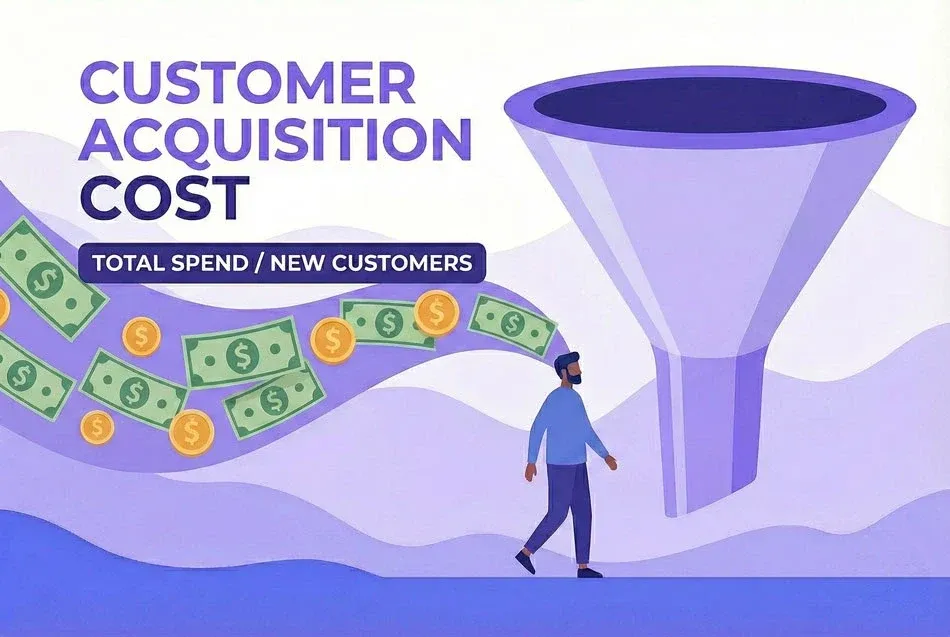
Customer Acquisition Cost measures how much you're spending to bring in each customer, which is essential for assessing the profitability of your marketing campaigns and deciding where to allocate resources. A high CAC might indicate overspending on customer acquisition or targeting the wrong audience, while a low CAC suggests efficient customer attraction, allowing more room for profit. Understanding this metric is the gateway to scaling your business sustainably.
While calculating Customer Acquisition Cost seems straightforward, it's essential to ensure you're including all related costs. This includes direct advertising spend, salaries, software tools, agency fees, and any other expenses tied to customer acquisition. Attribution also plays a crucial role; relying solely on last-click attribution (a marketing model which counts the customer's final touchpoint before a purchase as the reason for the conversion) can ignore the real effort involved in converting a user. Customers may interact with multiple ads and sessions before making a purchase, so understanding the entire customer journey is important for accurate CAC calculation.
How to Calculate CAC
CAC = Total Sales and Marketing Expenses / Number of New Customers Acquired
Give it a go in our CAC calculator!
CAC Calculator
Calculation Example
Suppose your business model requires keeping CAC at or below $75 to maintain profitability against your customer lifetime value targets. You're planning a quarterly marketing budget of $45,000. Calculate the minimum number of new customers you need to acquire to stay within your target CAC:
Number of New Customers = Total Marketing Expenses / Target CAC
Number of New Customers = $45,000 / $75
Number of New Customers = 600 Customers
Aim to acquire at least 600 new customers from your $45,000 quarterly marketing spend to maintain your target $75 CAC and ensure profitable customer acquisition.
What’s Considered a Healthy CAC?
A "healthy" CAC depends entirely on your business model, profit margins, and customer lifetime value (CLV). The fundamental rule is that CAC must be significantly lower than CLV to ensure sustainable growth:
● The CAC:CLV ratio is critical. Most successful ecommerce businesses aim for a 1:3 ratio, meaning if your CAC is $100, your customer lifetime value should be at least $300. Ratios below 1:3 indicate you're spending too much relative to customer value, while ratios above 1:5 suggest you may be under-investing in growth opportunities.
● Payback period matters as much as the ratio. Even with a healthy 1:3 CAC:CLV ratio, if it takes 24 months to recoup your acquisition cost, cash flow constraints could strangle growth. Aim for CAC payback within 12 months or less, ideally through first purchase plus early repeat orders.
● Industry and business model create wide variation. Subscription businesses can support higher CAC ($200-500) due to predictable recurring revenue, while low-margin consumables need much lower CAC ($20-50) to remain profitable. Luxury or high-ticket items ($500+ AOV) can justify CAC of $100-200, whereas fast-fashion or commodity products need CAC below $30.
● Customer type significantly impacts acceptable CAC. First-time customer acquisition typically costs 5-7x more than retaining existing customers. If your CAC is $80 but 40% of revenue comes from repeat customers acquired at near-zero cost, your blended economics may still be strong even if new customer CAC seems high.
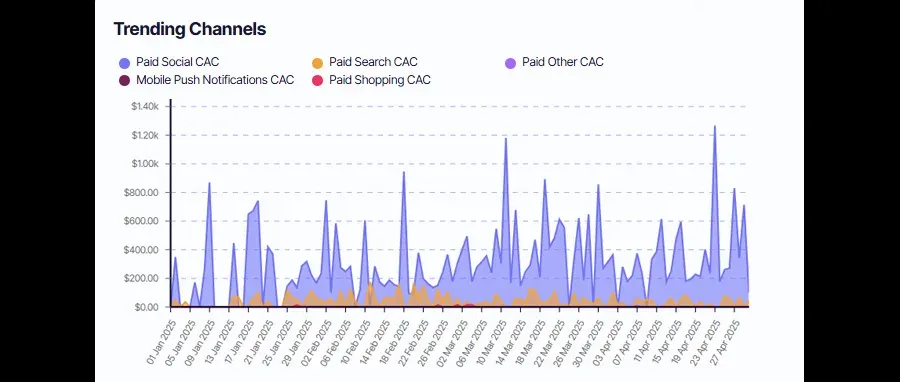
● Channel efficiency varies dramatically. Branded search might deliver $15 CAC, while cold prospecting on social media could run $150+ CAC. The key is ensuring each channel's CAC is profitable within that channel's context, not expecting uniform costs across all acquisition methods.
Tip: The most important benchmark isn't an industry average—it's whether your CAC enables profitable growth at your desired scale. Calculate your unit economics carefully, understanding both immediate profitability and the full customer journey economics.
CAC FAQ
What costs should I include when calculating CAC?
Include all expenses tied to customer acquisition: direct advertising spend (paid search, social ads, display), salaries for marketing and sales staff, marketing software and tools (email platforms, analytics, CRM), agency fees, content creation costs, and promotional discounts used for acquisition. Many businesses underestimate CAC by only counting ad spend, missing 40-60% of true acquisition costs. Even a portion of overhead costs like office space for your marketing team should be factored in for complete accuracy.
How does attribution model choice affect my CAC calculation?
Attribution models dramatically impact CAC accuracy. Last-click attribution typically underestimates CAC because it ignores the multiple touchpoints before conversion—the Facebook ad they saw last week, the email they opened, the search ad they clicked. First-click over-credits initial awareness channels. Multi-touch attribution provides the most accurate CAC by distributing credit across the customer journey, though it requires more sophisticated tracking. Without proper attribution, you might kill profitable channels or over-invest in ineffective ones.
Should I calculate CAC differently for different marketing channels?
Absolutely. Channel-specific CAC reveals where your marketing dollars work hardest. Email marketing might have $10 CAC while cold Facebook ads run $120 CAC. This doesn't mean Facebook is bad—those customers might have higher AOV or retention. Calculate CAC by channel, then evaluate each channel's CAC against that channel's customer quality metrics (AOV, repeat rate, CLV). This allows intelligent budget allocation rather than simply chasing the lowest CAC number.
How often should I calculate and review CAC?
Calculate CAC monthly to track trends and catch problems early, but evaluate performance over quarterly periods to account for seasonality and campaign lag effects. Some marketing efforts (content, SEO, brand building) take months to convert, so weekly CAC analysis can be misleading. However, if running active paid campaigns, monitor CAC weekly to catch efficiency drops quickly and adjust bids or targeting before wasting budget.
What if my CAC is higher than my average order value?
This isn't automatically fatal if your customer lifetime value is strong. Many subscription businesses have CAC 2-3x higher than first order value but profit handsomely from recurring revenue. The key is understanding time-to-payback and ensuring cash flow can support the model. If CAC exceeds AOV and you don't have strong repeat purchase rates, you need to either reduce CAC, increase AOV through upselling and bundles, or improve retention to make the economics work.
Can CAC be too low?
Yes. Extremely low CAC might signal you're under-investing in growth and missing market share opportunities. If competitors are outspending you and your CAC is far below industry norms, you may be leaving customers on the table. The goal isn't the lowest possible CAC—it's the optimal CAC that balances profitability with maximum sustainable growth. If your CAC:CLV ratio is 1:8 and you're cash-flow positive, consider increasing marketing spend to capture more market share while economics remain favorable.