Understanding LTV
LTV is a critical metric that extends your understanding of marketing performance beyond the first conversion. It tells you how much revenue a customer generates throughout their lifetime with your company, usually presented as an average across your customer base. This metric matters because it identifies and highlights high-value customers who contribute significantly to your profitability.
LTV enables you to make informed decisions about how much to invest in acquiring new customers and retaining existing ones, ultimately driving long-term profitability. By understanding the total value a customer brings over time, you can justify higher acquisition costs for customers who will generate significant long-term returns, while avoiding overspending on low-value customer segments.
How to Calculate LTV
LTV = Average Order Value × Average Purchase Frequency × Average Customer Lifespan
Give it a go in our ROI calculator!
LTV Calculator
Calculation Example
Suppose your business model requires an LTV of at least $800 to justify your current customer acquisition costs and maintain profitability. Your customers currently make purchases 3 times per year with an average order value of $60. Calculate the minimum customer lifespan you need to achieve your target LTV:
Customer Lifespan = Target LTV / (AOV × Purchase Frequency)
Customer Lifespan = $800 / ($60 × 3)
Customer Lifespan = $800 / $180 = 4.4 years
Aim to retain customers for at least 4.4 years through retention strategies, loyalty programs, and excellent service to achieve your target $800 LTV and maintain profitable unit economics.
What’s Considered a Healthy LTV?
A "healthy" ROI depends on your business model, profit margins, industry, and growth stage, but understanding the fundamental economics is critical:
● LTV:CAC ratio is the fundamental health metric. Most successful ecommerce businesses target a 3:1 ratio minimum—if CAC is $100, LTV should be at least $300. Ratios below 3:1 suggest overspending on acquisition relative to customer value; ratios above 5:1 indicate potential underinvestment in growth opportunities.
● Industry and business model create wide variation. Subscription businesses (software, consumables, memberships) often show LTV of $500-5,000+ due to predictable recurring revenue. One-time purchase businesses (furniture, appliances, special occasion items) typically see lower LTV ($200-800) as customers buy infrequently. Fashion and beauty with strong repeat patterns show LTV of $300-1,200.
● Product margin determines viable LTV floors. High-margin businesses (60-80% gross margin) can operate profitably with lower absolute LTV because each purchase contributes significant profit. Low-margin businesses (20-30% gross margin) need higher LTV to generate equivalent profit dollars. Always evaluate LTV in context of margin structure.
● Payback period matters alongside absolute LTV. A customer with $1,000 LTV realized over 4 years is less valuable than one with $1,000 LTV realized over 12 months due to cash flow and reinvestment considerations. Target LTV payback within 12-18 months for healthy cash flow dynamics.
● Customer segment variation is normal and valuable. Email subscribers might show LTV of $800 while social media acquires show $300 LTV. Geographic segments, demographic cohorts, and product category preferences all create LTV variation. This diversity enables targeted acquisition strategies rather than one-size-fits-all approaches.
Tip: The most important benchmark isn't an absolute LTV number—it's whether your LTV supports profitable customer acquisition at scale while maintaining healthy cash flow. Calculate your target LTV based on desired LTV:CAC ratio, available acquisition channels, and margin structure.
LTV FAQ
What's the difference between LTV and CLV?
LTV (Lifetime Value) and CLV (Customer Lifetime Value) are identical metrics with different abbreviations. The terms are used interchangeably across the industry. Some businesses prefer LTV, others CLV—both refer to the total revenue or profit a customer generates over their entire relationship with your business. Use whichever term is standard in your organization but ensure everyone calculates it consistently.
Should I calculate LTV using revenue or profit?
Both are valuable for different purposes. Revenue-based LTV (most common) shows total customer spending, useful for top-line forecasting and acquisition budget setting. Profit-based LTV subtracts cost of goods sold, shipping, and fulfillment costs from revenue, showing true economic value. Profit-based LTV is more accurate for ROI analysis and strategic decisions. Many businesses track both—revenue LTV for marketing, profit LTV for finance. Always clarify which version you're using when sharing numbers.
How long should I wait to calculate meaningful LTV?
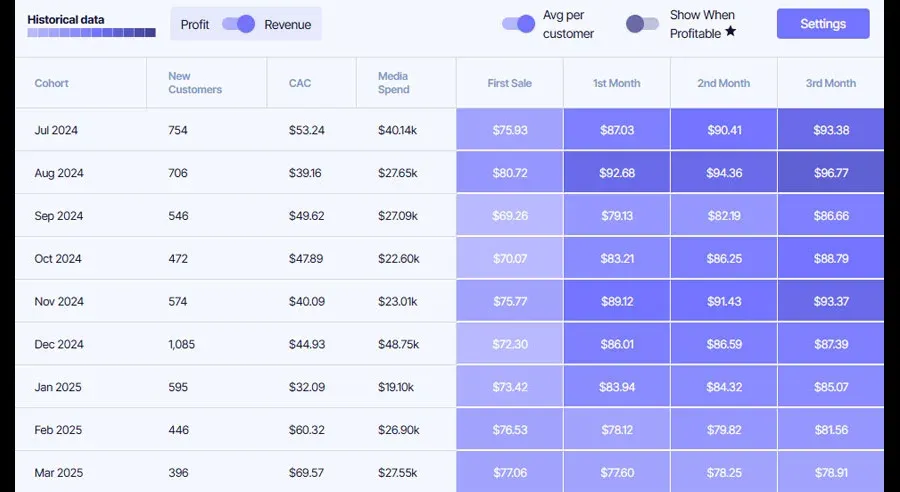
You need at least 12 months of customer cohort data for reliable LTV estimates. Customers acquired in January can have their 12-month LTV calculated by the following January, revealing repeat purchase patterns, churn rates, and average lifespan. For businesses with longer purchase cycles (furniture, appliances), wait 18-24 months. Use historical cohort LTV to set expectations for newly acquired customers rather than trying to calculate LTV immediately.
Why is my LTV:CAC ratio low even though I'm profitable?
Low LTV:CAC ratio (below 2:1) with positive profitability typically indicates high gross margins compensating for inefficient customer economics. You might have 70% margins that make even 1.5:1 LTV:CAC profitable, but you're leaving money on the table. Low ratios also suggest either overspending on acquisition or underperforming on retention. Improving the ratio through better targeting or retention strategies would dramatically increase profitability even if you're currently profitable.
How does customer churn rate affect LTV?
Churn rate directly determines customer lifespan, which is one-third of the LTV calculation. If 20% of customers churn annually, average lifespan is 5 years (1 / 0.20). If churn increases to 30%, lifespan drops to 3.3 years (1 / 0.30), reducing LTV by 33% with no other changes. Even small churn improvements drive significant LTV increases. Reducing churn from 25% to 20% increases LTV by 25%, making retention optimization one of the highest-leverage activities for LTV improvement.
Can LTV be too high relative to CAC?
Yes. LTV:CAC ratios above 5:1 often signal underinvestment in growth. If you're achieving 8:1 ratios, you could likely increase acquisition spending significantly while maintaining 3:1 ratios and capture far more market share. High ratios with flat revenue suggest you're optimizing for efficiency while competitors invest aggressively in growth. The goal is optimal LTV:CAC that balances profitability with maximum sustainable growth, not maximum ratio at minimal scale.