Understanding MER
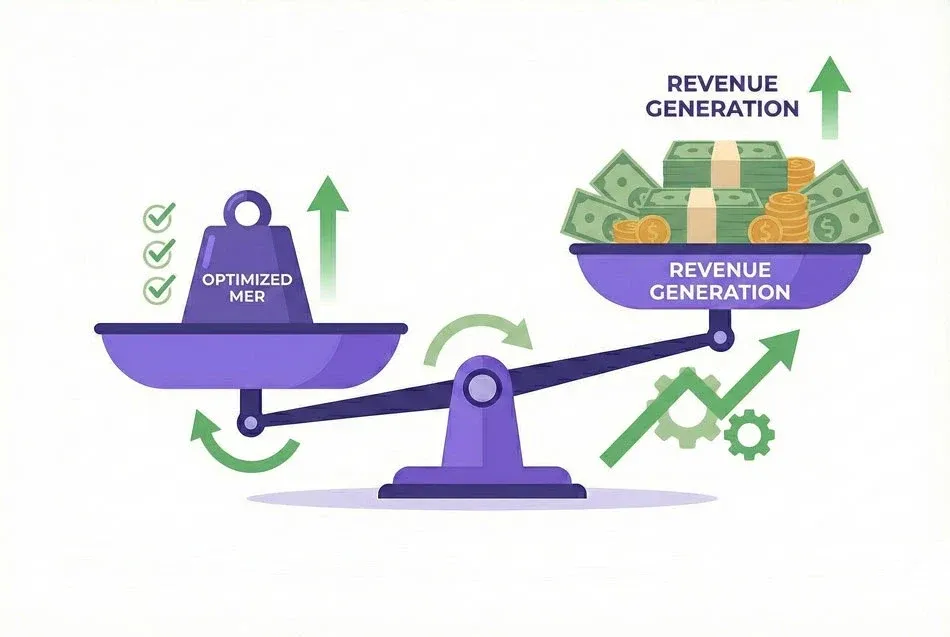
MER serves as a top-level health metric, offering a quick snapshot of overall marketing efficiency. By setting and tracking a target MER, businesses can gauge whether they are on course to achieve their revenue goals and adjust their strategies accordingly. Marketing Efficiency Ratio complements more granular metrics, providing context for individual campaign performances within the broader marketing landscape.
The key difference between MER and ROAS lies in granularity: ROAS focuses on revenue generated by a specific advertising campaign or channel divided by the cost of that particular activity, while MER looks at total revenue generated by all marketing efforts divided by total marketing spend across all channels and campaigns.
How to Calculate MER
MER = Total Revenue / Total Marketing Spend
Give it a go in our MER calculator!
MER Calculator
Calculation Example
Suppose your business aims for $80,000 in revenue next month with an average order value (AOV) of $160 and a target cost per acquisition (CPA) of $25. First, determine the number of orders needed:
Number of Orders = Revenue Goal / AOV = $80,000 / $160 = 500 orders
Next, estimate total marketing spend:
Total Marketing Spend = Number of Orders × CPA = 500 × $25 = $12,500
Finally, calculate target MER:
MER = Revenue Goal / Total Marketing Spend = $80,000 / $12,500 = 6.4
A target MER of 6.4 means you aim to generate $6.40 in revenue for every dollar spent on marketing.
What’s Considered a Healthy MER?
A "healthy" MER depends on your business model, profit margins, and growth stage. While there's no universal benchmark, understanding what drives sustainable MER is critical:
● Profit margins determine viable MER floors. If your gross margin is 40%, you need MER above 2.5 just to break even on marketing spend (1 / 0.40 = 2.5). Businesses with 60% margins can operate profitably at MER of 1.67, while those with 25% margins need MER above 4.0 to stay solvent.
● Growth stage influences acceptable MER levels. Early-stage businesses prioritizing market share may accept MER of 2-3 while building brand awareness and customer base. Established businesses optimizing for profitability typically target MER of 4-8 depending on their margin structure and operational efficiency.
● Product type and pricing affect typical ranges. High-ticket items with longer sales cycles (furniture, electronics) often show MER of 3-5 due to higher acquisition costs and consideration periods. Fast-moving consumer goods with quick purchase decisions may achieve MER of 6-10 through efficient conversion and repeat purchases.
● Channel mix significantly impacts MER. Businesses heavily reliant on paid advertising typically see lower MER (2-4) than those with strong organic, email, and retention channels (5-10+). Diversified marketing approaches with cost-effective channels naturally improve blended MER.
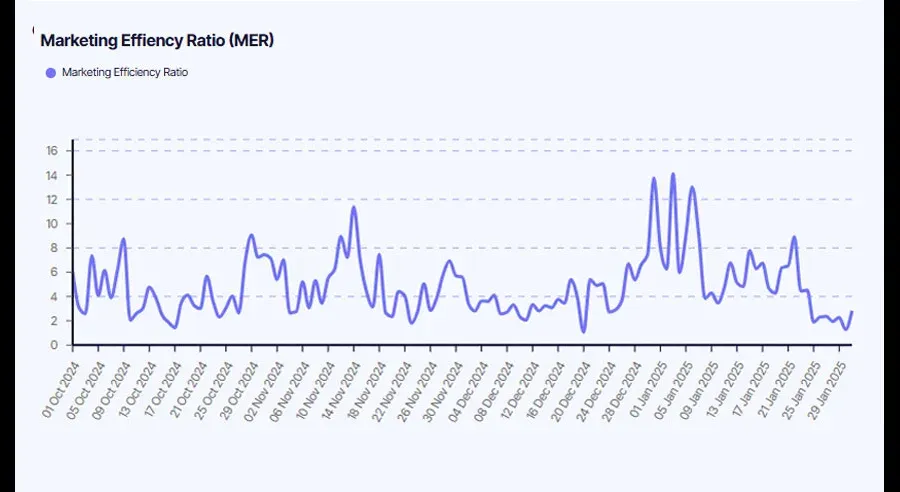
● Seasonal variation is normal. MER typically peaks during high-converting periods (holidays, sales events) when conversion rates rise and CAC drops, then dips during slower periods. Track MER trends over time rather than fixating on single data points.
Tip: The most important benchmark is whether your MER supports profitable growth at your current margin structure. Calculate your breakeven MER, then target 50-100% above that level to ensure healthy profitability while maintaining growth capacity.
MER FAQ
How is MER different from ROAS?
MER measures total revenue against total marketing spend across all channels, while ROAS evaluates individual campaigns or channels. MER is your 30,000-foot view showing overall marketing efficiency; ROAS is the ground-level view revealing which specific tactics work. Use MER to assess overall health and set budgets, use ROAS to optimize individual campaigns and allocate spend between channels. Both metrics are essential—MER for strategy, ROAS for execution.
What's the biggest mistake when using MER?
Focusing solely on improving MER can lead to cutting marketing spend, which harms long-term growth. Increasing MER by reducing investment might boost efficiency but shrink revenue. The goal isn't maximum MER—it's optimal MER that balances profitability with growth. A business generating $100k revenue at MER of 5 outperforms one generating $50k at MER of 7. Always evaluate MER alongside absolute revenue and growth objectives.
Should I include all marketing costs in MER or just ad spend?
Include all marketing costs for accurate MER: paid advertising, marketing salaries, agency fees, software tools, content creation, and promotional discounts. Calculating MER with ad spend only understates true costs and overstates efficiency by 40-60% for most businesses. However, some businesses track both "media MER" (ad spend only) and "total MER" (all costs) for different purposes—media MER for channel optimization, total MER for business health.
How does MER account for returns and refunds?
MER focuses on gross revenue versus marketing spend and doesn't directly account for returns, refunds, or fulfillment costs. For businesses with high return rates (10%+), net revenue MER provides a more accurate picture. Calculate this by subtracting returns and refunds from total revenue before dividing by marketing spend. Industries like fashion with 20-30% return rates should always use net revenue MER to avoid false confidence in marketing efficiency.
Can MER be too high?
Yes. Extremely high MER (10+) often signals underinvestment in growth. If your MER is 12 and competitors are profitably operating at 4-5, you're likely leaving market share on the table. High MER with flat or declining revenue suggests missed opportunities to scale. The optimal MER balances profitability with maximum sustainable growth—not the highest possible efficiency at the expense of revenue potential.
How should MER change as my business scales?
MER typically decreases slightly as businesses scale due to increased competition for customer attention and market saturation. Early-stage businesses with untapped markets might achieve MER of 8-10, which gradually compresses to 4-6 as they grow and saturate their core audience. This is normal and healthy—volume growth at stable profitability beats high efficiency at low volume. Focus on maintaining MER above your breakeven threshold while maximizing absolute revenue and profit dollars.